

The acronym STEM, encompassing Science, Technology, Engineering, and Math, represents some of the most rapidly evolving fields in the modern world. These fields hold the potential to address global challenges, drive innovation, and shape the future. However, despite their significance, women remain significantly underrepresented in STEM careers.
This blog post serves as a STEMinist Manifesto, outlining the existing challenges, exploring the importance of diversity in STEM, and proposing actionable steps toward empowering women in these crucial fields.
The Current Landscape of Inequality: A Need for Change
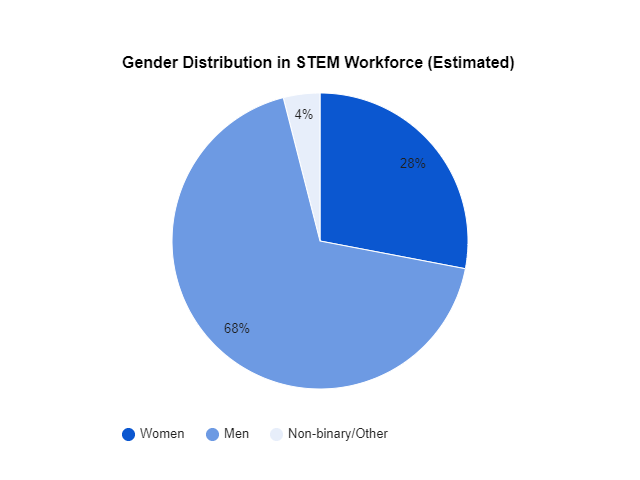
Statistics paint a sobering picture of the gender gap in STEM:
- Women make up only 28% of the workforce in STEM occupations in the United States, according to the National Center for Science and Engineering Statistics (NCES).
- This gap is even wider in specific fields: Only 13% of engineers and 26% of computer and mathematical occupations are held by women.
- Globally, the story is similar: UNESCO data suggests that only 35% of all researchers globally are women.
These figures highlight the alarming underrepresentation of women in STEM fields, despite their immense potential and talent.
The Importance of Gender Diversity in STEM
Addressing the gender gap in STEM is not just about fairness and equal opportunity. It’s also about harnessing the full potential of diverse minds to tackle complex challenges and drive innovation.
Here’s why diversity in STEM matters:
- According to Forbes about gender diversity, a wider range of perspectives leads to better solutions: When diverse voices and experiences are included, it fosters broader thinking, creativity, and problem-solving approaches.
- Inclusion leads to innovation: Studies have shown that teams with greater diversity outperform homogenous teams in terms of creativity and innovation, according to a report by McKinsey & Company.
- Role models inspire future generations: Seeing successful women in STEM careers inspires younger girls to pursue similar paths, creating a positive cycle of representation and inclusion, as highlighted by the American Association of University Women (AAUW).
Breaking Down Barriers: Challenges and Solutions
Several factors contribute to the existing gender gap in STEM:
- Unconscious bias: Stereotypes and implicit biases, both conscious and unconscious, can discourage girls from pursuing STEM education and careers, as explored by the National Academies of Sciences, Engineering, and Medicine (NASEM).
- Lack of role models: The underrepresentation of women in STEM leadership roles creates a dearth of role models for young girls, making it harder to envision themselves in these careers, as noted by the Harvard Business Review.
- Work-life balance challenges: The demanding nature of some STEM careers, coupled with societal expectations of childcare and domestic responsibilities, can disproportionately impact women’s career advancement in these fields, according to a study by the Pew Research Center.
To address these challenges, a multi-pronged approach is needed:
- Combatting unconscious bias: Educational programs and workshops like those offered by the Clayman Institute for Gender Research can help individuals and institutions identify and challenge unconscious biases that hinder equal opportunities in STEM fields.
- Promoting role models and mentorship: Highlighting the achievements of successful women in STEM, like those featured by the National Girls Collaborative (NGC), and facilitating mentorship programs through organizations like Big Brothers Big Sisters of America (BBBSA) can inspire younger girls and provide valuable guidance and support.
- Encouraging flexible work arrangements: Implementing flexible work policies and childcare support systems, as advocated by the Society of Women Engineers (SWE), can help create a more inclusive work environment for women in STEM, allowing them to balance their professional and personal lives effectively.
- Enhancing STEM education for girls: Encouraging girls to participate in STEM activities from a young age, providing them with access to quality STEM education, and fostering a supportive learning environment can spark their interest and equip them with the necessary skills to thrive in these fields. Initiatives like those offered by the National Science Foundation (NSF) and the Malala Fund are crucial in achieving this goal.
The STEMinist Movement: A Call to Action

The STEMinist movement is a collective effort to empower women in STEM and achieve gender equality in these crucial fields. This movement is not just about individual success; it’s about building a future where everyone, regardless of gender, has the opportunity to contribute their unique talents and perspectives to scientific discovery, technological advancement, and problem-solving on a global scale.
Here are some ways you can join the movement:
- Advocate for STEM education for girls: Support initiatives and programs that encourage girls’ participation in STEM activities and education. You can volunteer your time, donate resources, or simply spread awareness in your community.
- Challenge gender stereotypes: Speak out against harmful stereotypes that discourage girls from pursuing STEM careers. Educate yourself and others about unconscious bias and its impact on career choices.
- Mentor young girls: Share your knowledge and experience with young girls interested in STEM fields. Consider becoming a mentor through organizations like Boys & Girls Clubs of America (BGCA) or Girls Who Code to make a direct impact.
- Support organizations working towards gender equality in STEM: Donate your time, resources, or financial support to organizations working to close the gender gap in STEM, such as the American Association for the Advancement of Science (AAAS) or AnitaB.org.
The Last Note for Gender Equality in STEM
Bridging the gender gap in STEM is imperative not only for achieving gender equality but also for unlocking the full potential of human talent. By fostering a culture of inclusion, challenging biases, and providing resources and support, we can empower women to pursue their dreams in STEM fields and contribute to a brighter future for all.
Remember, the STEMinist movement is not just about achieving equality; it’s about building a world where innovation thrives through the diverse contributions of all individuals.
#STEMinist #WomenInSTEM #GenderEquality #STEMEducation #Empowerment
Subscribe to our Newsletter :)

